Multithreading and concurrency are core elements in developing Java applications that deliver speed, stability, and efficiency. As modern systems handle higher user interaction and massive data flows, the ability to run multiple operations simultaneously becomes indispensable. Java’s well-structured concurrency features help developers minimize delays, enhance responsiveness, and build applications that remain reliable even under demanding conditions. Enhance your programming skills and build a strong foundation in software development with our Java Course in Chennai, designed to help you master core to advanced Java concepts through hands-on training.
Understanding Multithreading in Java
Multithreading equips Java programs with the capability to run several tasks at the same time within a single application. By utilizing the Thread class and Runnable interface, developers can move long-running processes to background threads, ensuring that the main application remains uninterrupted. This parallel execution approach significantly improves user experience and makes full use of multi-core processors.
Concurrency and Rising Application Demands
Concurrency deals with managing multiple activities that execute in parallel while accessing shared resources safely. As applications increasingly prioritize real-time responsiveness and complex data handling, Java’s concurrency utilities become essential. Thread pools, atomic variables, and locking mechanisms help developers coordinate operations, prevent conflicts, and maintain consistent behavior under high load.
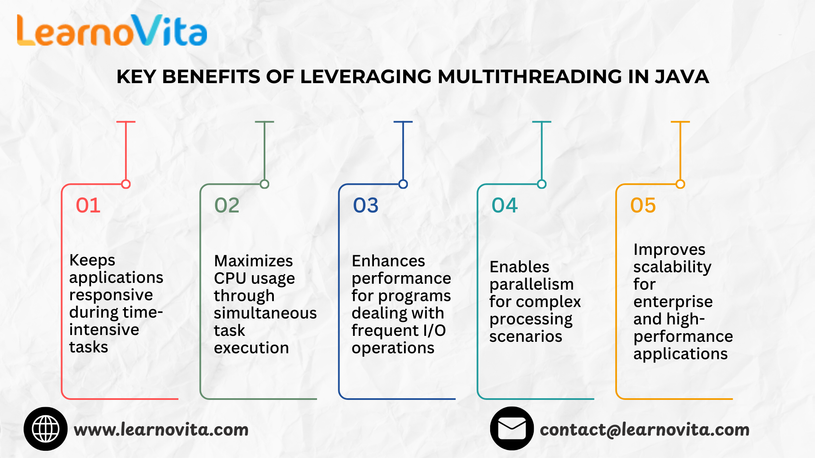
Advantages of Using Multithreading in Java
- Increases responsiveness during lengthy or intensive tasks
- Optimizes processor usage through parallel execution
- Enhances performance for I/O-heavy applications
- Supports efficient parallel computing for complex logic
- Improves scalability for enterprise and high-demand systems
Common Concurrency Challenges Developers Face
- Data inconsistencies caused by improper synchronization
- Deadlocks triggered when threads wait indefinitely
- Race conditions from simultaneous updates on shared data
- Difficulty troubleshooting thread-related issues
- High resource consumption from unmanaged thread creation
Advance your coding expertise from anywhere with our Java Online Course, offering comprehensive training in core and advanced Java concepts through interactive, instructor-led sessions.
Thread Pools and Executors for Streamlined Task Execution
The Java Executor Framework simplifies concurrency by offering a structured way to run tasks without manually managing each thread. Thread pools reuse existing threads, allowing applications to handle large task volumes efficiently. This reduces unnecessary overhead and ensures smoother performance—especially important for server-side and distributed environments.
Synchronization for Safe Access to Shared Data
Whenever multiple threads work with the same data, proper synchronization ensures predictable and accurate outcomes. Java provides several options, including synchronized methods, ReentrantLock, and atomic classes, to control access and maintain data integrity. These mechanisms enable concurrent operations to run smoothly without causing conflicts or unexpected behavior.
Conclusion
Multithreading and concurrency play vital roles in building Java applications that meet modern performance expectations. By leveraging Java’s concurrency frameworks, synchronization tools, and advanced thread management techniques, developers can create systems that are fast, resilient, and adaptable. As application demands continue to evolve, mastering these concepts is essential for producing high-quality, future-proof Java solutions.